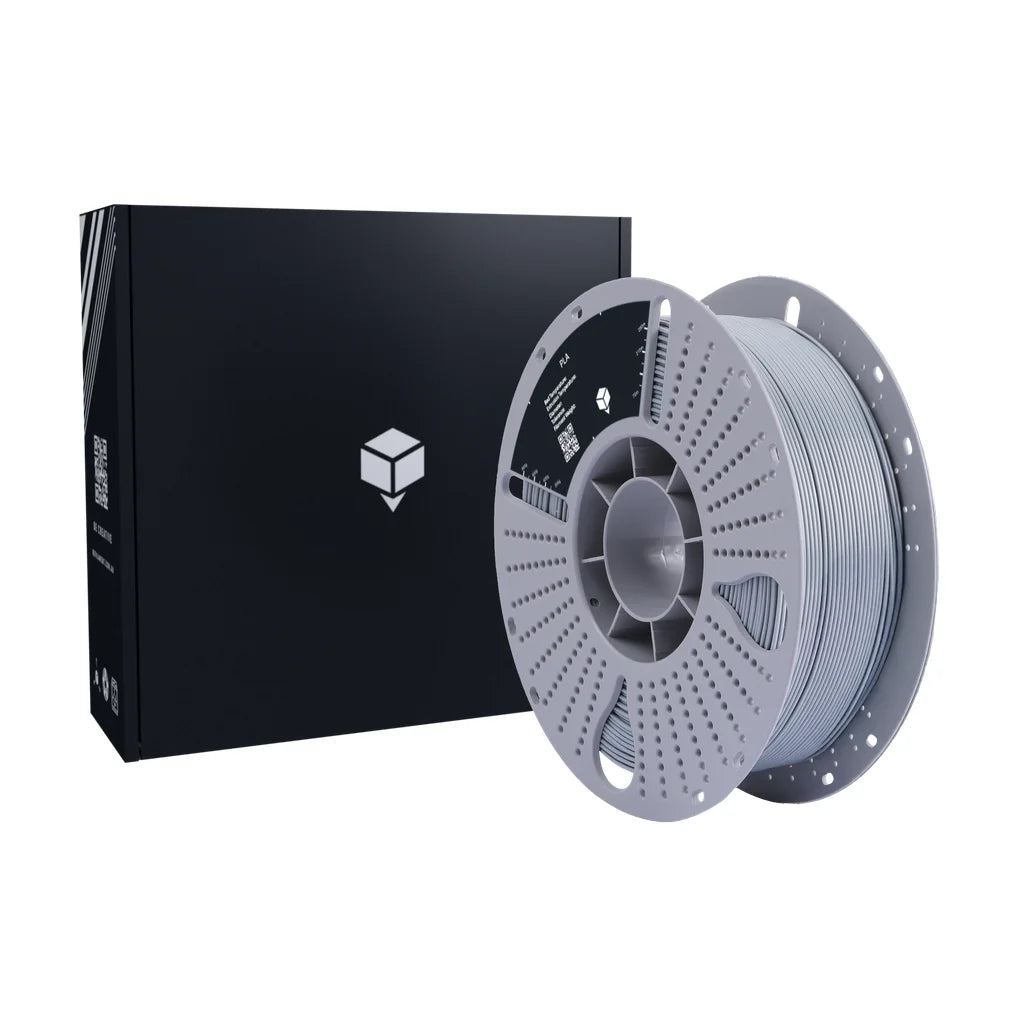

Collection: All PLA

Explore our full range of PLA filaments. Known for their ease of use and excellent print quality, these filaments are perfect for a wide variety of 3D printing applications, from detailed models to everyday objects.

52 products

About PLA Filament

PLA (Polylactic Acid) is the world's most popular 3D printing material, valued for its ease of use, reliability, and versatility. Made from renewable resources like corn starch or sugarcane, PLA prints at low temperatures, requires minimal hardware, and produces exceptional surface quality. Our complete PLA range offers solutions for every application—from standard everyday printing to specialised aesthetic finishes.

Our PLA collection includes six distinct variants: Standard PLA for reliable everyday printing with glossy finish; PLA Matte for refined, non-reflective surfaces; PLA Silk for lustrous, satin-like sheen; PLA Marble for natural stone-like patterns; PLA Wood for authentic timber aesthetics with wood fibres; and PLA Glow for glow-in-the-dark effects. All variants share PLA's core advantages—easy printing, excellent detail resolution, and wide printer compatibility—while offering unique visual characteristics.

PLA excels at producing detailed models, prototypes, decorative items, and visual aids. While not suitable for high-temperature or high-stress applications, PLA's accessibility, print success rate, and aesthetic versatility make it the ideal choice for educational projects, rapid prototyping, artistic creations, and any application prioritising visual quality over mechanical performance. All our PLA filaments are manufactured to tight tolerances of ±0.02mm at 1.75mm diameter for consistent results across every variant.

When to Choose PLA Filament

Choose PLA when you need reliable, high-quality prints with specific aesthetic requirements. Select standard PLA for everyday projects with glossy finish. Choose Matte PLA when you need refined, professional surfaces without glare. Select Silk PLA for eye-catching, lustrous parts that photograph beautifully. Use Marble PLA for decorative items with natural stone appearance. Choose Wood PLA for organic, timber-like aesthetics. Select Glow PLA for novelty items and parts requiring visibility in darkness.

PLA is ideal for miniatures and figurines, architectural models, concept prototypes, educational demonstrations, decorative household items, cosplay props, artistic sculptures, signage and displays, and rapid iteration where print success matters more than material strength. The wide variety of PLA finishes allows you to match the material to your aesthetic vision while maintaining easy printability.

PLA suits all skill levels from complete beginners to professionals. It's the recommended starting material for learning 3D printing, while advanced users choose specific PLA variants to achieve precise visual effects. The material's forgiving nature means high success rates regardless of experience level, making it ideal for educational settings, maker spaces, and production environments requiring consistent output.

Consider alternatives if you need heat resistance above 50-60°C, impact resistance for functional parts, flexibility, or outdoor UV resistance. For these applications, explore PETG, ABS, ASA, or TPU. PLA excels in its intended applications—visual quality, ease of use, and aesthetic versatility—but isn't designed for demanding mechanical or environmental conditions.

PLA Variant Comparison

Each PLA variant offers unique aesthetic properties while maintaining the core benefits of easy printing and excellent detail capture. Understanding the differences helps you select the right variant for your project's visual requirements.

Variant Surface Finish Best For Special Properties
Standard PLA Glossy, smooth General purpose, prototypes Widest colour range, most economical
PLA Matte Non-reflective, refined Professional models, photography Reduces glare, hides layer lines
PLA Silk Lustrous, satin sheen Decorative items, display pieces Pearlescent effect, vibrant colours
PLA Marble Stone-like patterns Decorative objects, sculptures Natural marble appearance, unique patterns
PLA Wood Textured, timber-like Organic designs, natural aesthetics Contains wood fibres, can be stained/sanded
PLA Glow Smooth, glows in dark Novelty items, safety markers Phosphorescent, charges with light

All PLA variants print with identical temperature settings and compatibility. The choice between variants is purely aesthetic—select based on the visual effect you want to achieve. You can switch between PLA variants on the same printer without recalibration, making it easy to experiment with different finishes for various projects.

Printing PLA Successfully

All PLA variants share the same core printing requirements, making them interchangeable without significant slicer adjustments. Wood PLA may benefit from slightly lower temperatures to prevent nozzle clogging, while other variants use standard PLA settings.

Temperature settings: Nozzle temperatures range from 190-220°C for all variants, with 200-210°C being optimal for most. Wood PLA prints well at the lower end (190-205°C) to prevent darkening. Bed temperature should be 40-60°C when using a heated bed, or room temperature with proper adhesion aids. Higher bed temperatures improve adhesion but aren't essential for PLA.

Speed and cooling: PLA prints reliably at 50-80mm/s across all variants. Enable 100% part cooling after the first layer for best overhangs and detail resolution. Wood PLA benefits from slightly reduced cooling (50-75%) to maintain layer adhesion. All variants capture fine details excellently when printed with proper cooling and moderate speeds.

Variant-specific notes: Wood PLA contains fibres that can clog small nozzles—use 0.4mm or larger and consider a hardened steel nozzle for extended use. Silk and Marble PLA may show visible layer lines more prominently than Matte—adjust layer heights accordingly. Glow PLA requires exposure to bright light before glowing. Matte PLA naturally conceals layer lines better than glossy variants, reducing post-processing needs.

Printer Compatibility

All PLA variants work on every FDM 3D printer without special requirements. The only exception is Wood PLA, which benefits from hardened steel nozzles for extended printing due to abrasive wood fibres, though standard brass nozzles work for occasional use.

  • Universal compatibility: Every PLA variant prints successfully on budget to professional printers from all major brands—Prusa, Bambu Lab, Creality, AnyCubic, Elegoo, Artillery, and more. No special hardware or modifications required beyond standard FDM capabilities.
  • Heated bed optional: While beneficial, heated beds aren't essential. All PLA variants adhere to painter's tape, glue stick, or PEI surfaces at room temperature. A heated bed at 50-60°C improves reliability for larger prints.
  • No enclosure needed: PLA variants print successfully on open-frame printers in normal room conditions without warping. Enclosures provide no benefit for PLA and may cause overheating issues if not properly ventilated.
  • Wood PLA nozzle consideration: Wood fibres are mildly abrasive. Standard brass nozzles work fine for occasional Wood PLA printing. If printing Wood PLA frequently, consider a hardened steel nozzle to prevent gradual wear. Use 0.4mm nozzles or larger to prevent clogging.

PLA's universal compatibility makes it ideal for educational institutions, maker spaces, and multi-user environments where printer variety is common. You can confidently purchase any PLA variant knowing it will work on your existing equipment without configuration changes.

PLA Filament FAQs

Choose based on desired appearance: Standard PLA for general use with glossy finish; Matte for refined, professional surfaces; Silk for lustrous, eye-catching parts; Marble for decorative stone-like items; Wood for natural timber aesthetics; Glow for novelty or visibility in darkness. All variants print identically—the choice is purely aesthetic.
All variants use the same temperature range (190-220°C nozzle, 40-60°C bed) with minor exceptions: Wood PLA prints slightly cooler (190-205°C) to prevent darkening and may need reduced cooling. Otherwise, you can switch between PLA variants without changing slicer profiles, making experimentation easy.
Yes, brass nozzles work fine for occasional Wood PLA printing. The wood fibres are mildly abrasive and cause gradual wear over extended use. For frequent Wood PLA printing, consider a hardened steel nozzle. Use 0.4mm nozzles or larger to prevent clogging from wood particles.
Glow PLA contains phosphorescent pigments that charge when exposed to light and glow for 15-30 minutes afterward, with brightness fading gradually. Brighter charging light (sunlight or UV) produces stronger, longer-lasting glow. The glow effect recharges indefinitely—parts don't lose their glow-in-the-dark properties over time.
Store all PLA variants in airtight containers or sealed bags with silica gel desiccant to prevent moisture absorption. While less hygroscopic than nylon or PETG, PLA gradually absorbs humidity, causing stringing and poor surface quality. If filament has absorbed moisture, dry at 45-50°C for 4-6 hours in a filament dryer before printing.