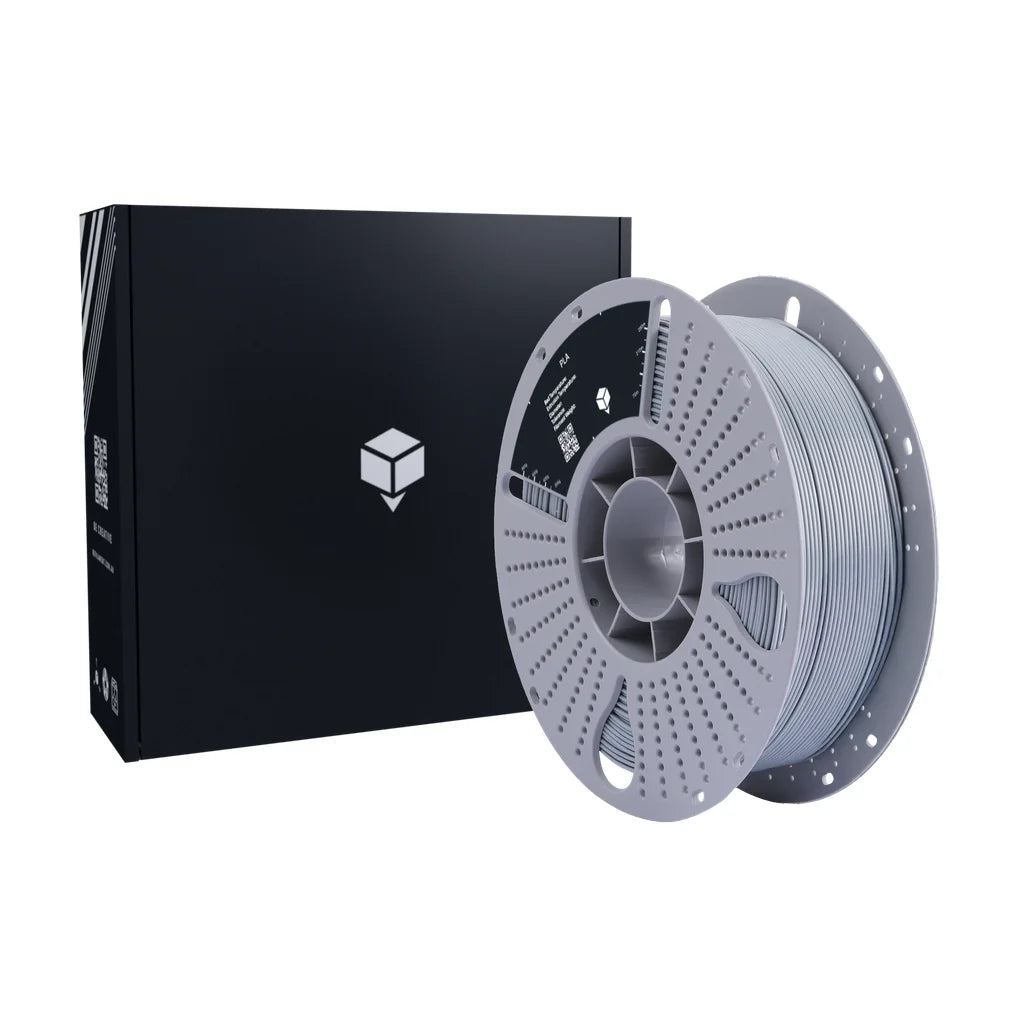

Collection: PETG

Durable and impact-resistant, PETG combines the strength of ABS with the ease of PLA. Ideal for functional parts and outdoor applications, it delivers a reliable, long-lasting finish for your 3D prints.

13 products

About PETG Filament

PETG (Polyethylene Terephthalate Glycol-modified) is a versatile 3D printing material that combines the ease of printing similar to PLA with enhanced mechanical properties approaching those of ABS. It offers excellent layer adhesion, good impact resistance, and moderate heat tolerance, making it a popular choice for functional parts that require durability without the complexity of high-temperature materials.

PETG is a glycol-modified version of PET, the same plastic used in drink bottles, making it food-safe when printed under appropriate conditions. The material provides a glossy, slightly translucent finish and maintains dimensional stability during printing with minimal warping. Its combination of strength, flexibility, and chemical resistance makes it suitable for mechanical parts, protective cases, containers, and functional prototypes. Our PETG filament is manufactured to tight tolerances of ±0.02mm at 1.75mm diameter for consistent, reliable performance.

The material strikes a practical balance between printability and performance. PETG is more forgiving than ABS regarding temperature control and warping, yet delivers superior strength and durability compared to PLA. It resists moisture and chemicals better than PLA, maintains integrity at higher temperatures, and exhibits good UV resistance for outdoor applications. The slight flexibility prevents brittle failure under stress, making it ideal for parts that experience regular handling or mechanical loads.

When to Choose PETG Filament

PETG excels when you need durable, functional parts with reliable printing characteristics. It's ideal for mechanical components, protective enclosures, outdoor applications, containers, and parts that experience regular handling or moderate stress. Choose PETG when you want better strength than PLA without the printing challenges of ABS.

Select PETG for parts requiring impact resistance, moderate temperature tolerance (up to 70-80°C), or exposure to moisture and chemicals. It's commonly used for tool holders, jigs and fixtures, custom brackets, RC vehicle parts, protective cases, and functional household items. The material's combination of strength and slight flexibility makes it excellent for parts with snap-fit connections or living hinges.

PETG suits beginners to advanced users who want reliable functional prints. It works on most printers with heated beds and doesn't require an enclosure, making it more accessible than ABS. The material is forgiving during printing while delivering professional results. It's well-suited for users transitioning from PLA to more functional materials.

Consider alternatives if you need the absolute highest strength (use ABS, nylon, or polycarbonate), require printing fine details with minimal stringing (use PLA), or need parts for sustained high-temperature environments above 80°C (use ABS or ASA). PETG can be stringy if settings aren't optimised, and its glossy surface may show fingerprints and scratches more readily than matte materials.

PETG vs Alternative Filaments

Understanding how PETG compares to other common filaments helps you select the right material for your application. PETG occupies the middle ground between easy-to-print materials and high-performance engineering plastics, making it a versatile choice for many projects.

Property PETG PLA ABS TPU
Durability Good impact resistance Brittle under stress High impact resistance Excellent flexibility
Heat Resistance 70-80°C 50-60°C 90-100°C 60-70°C
Print Difficulty Moderate Easy Moderate to hard Moderate to hard
Typical Applications Mechanical parts, containers Models, prototypes Functional parts, tooling Flexible parts, grips
Chemical Resistance Good Limited Moderate Good

PLA is easier to print with less stringing, but lacks the durability and temperature resistance needed for functional parts. ABS offers higher heat resistance and can be acetone-smoothed, but requires an enclosure and proper ventilation. TPU provides flexibility and excellent impact absorption, but is challenging to print and not suitable for rigid structural parts.

If PETG isn't the right choice for your application, explore our PLA, ABS, or TPU filament collections for alternative materials.

Printing PETG Successfully

PETG is relatively forgiving but benefits from attention to temperature settings and print speed. The material's tendency to string can be managed through proper retraction settings and temperature control, while its excellent layer adhesion makes it reliable for functional prints.

Temperature settings: Nozzle temperatures typically range from 220-250°C, with most users finding success around 230-240°C. Bed temperature should be set between 60-80°C, with 70°C being a common starting point. PETG adheres very well to print surfaces, so avoid excessive bed temperatures that may cause parts to bond too strongly.

Environment and hardware: PETG doesn't require an enclosed build chamber, though one can help with large prints. A heated bed with proper adhesion surface (PEI, textured powder-coated steel, or painter's tape) works well. Use minimal part cooling (0-50%) for best layer adhesion, especially on first layers. Too much cooling can cause poor layer bonding, while too little increases stringing. Reduce print speed to 40-60mm/s for best results, as PETG needs time to properly bond between layers.

Common challenges: Stringing is the primary concern with PETG. Optimise retraction settings (typically 3-6mm for Bowden, 1-3mm for direct drive) and reduce nozzle temperature in 5°C increments if stringing persists. PETG can stick too well to smooth print surfaces—use a release agent or textured surface to prevent damage when removing prints. The material is hygroscopic, so store it properly and dry it if you notice bubbling or poor surface quality during printing.

Printer Compatibility

PETG works on virtually all FDM printers with heated beds. It doesn't require special hardware like enclosed chambers, making it accessible for most users while delivering functional results.

  • Heated bed requirement: Essential. PETG requires bed temperatures of 60-80°C for proper first-layer adhesion. Printers without heated beds cannot reliably print PETG.
  • All-metal hotend recommended: While not strictly required, an all-metal hotend is beneficial for printing at higher temperatures (240-250°C) if needed. PTFE-lined hotends work at lower PETG temperatures but may degrade over time.
  • Direct drive vs Bowden: Both work well with PETG. Direct drive systems typically have less stringing due to shorter retraction distances, but properly tuned Bowden setups print PETG successfully with adjusted retraction settings.
  • Build surface: Textured PEI sheets, powder-coated steel, or painter's tape work excellently. Avoid smooth glass or PEI as PETG may bond too strongly and damage the surface during removal.

Most modern printers from Prusa, Bambu Lab, Creality, AnyCubic, Elegoo, and Ender series can print PETG when properly configured. Check that your printer can maintain bed temperatures of at least 60°C and nozzle temperatures up to 250°C.

PETG Filament FAQs

PETG is made from food-safe material (similar to drink bottles), but 3D printed PETG parts have layer lines that can harbour bacteria, making them unsuitable for repeated food contact without proper finishing. For single-use or non-contact food applications, PETG is generally acceptable. Avoid using brass nozzles for food-safe prints as they may contain lead.
Reduce nozzle temperature in 5°C increments, optimise retraction settings (typically 3-6mm for Bowden, 1-3mm for direct drive), increase retraction speed, and reduce print speed slightly. Ensure your filament is dry, as moisture increases stringing. A temperature tower test helps identify the optimal temperature for minimal stringing.
Increase bed temperature to 70-80°C, ensure the bed is properly levelled, increase first layer height slightly (0.2-0.3mm), and verify your print surface is clean. PETG adheres well to textured PEI, powder-coated steel, and painter's tape. Using a glue stick or hairspray can improve adhesion if needed.
Store PETG in an airtight container with silica gel desiccant to prevent moisture absorption. PETG is moderately hygroscopic and will absorb moisture over time, leading to printing issues like bubbling, poor surface finish, and reduced layer adhesion. If your PETG has absorbed moisture, dry it in a filament dryer or food dehydrator at 65°C for 4-6 hours.
Yes, PETG has good UV resistance and performs well in outdoor applications. While not as UV-resistant as ASA, PETG maintains its properties better than PLA when exposed to sunlight and weather. It's suitable for outdoor enclosures, garden fixtures, and functional outdoor parts that don't require extreme temperature resistance or long-term UV exposure.