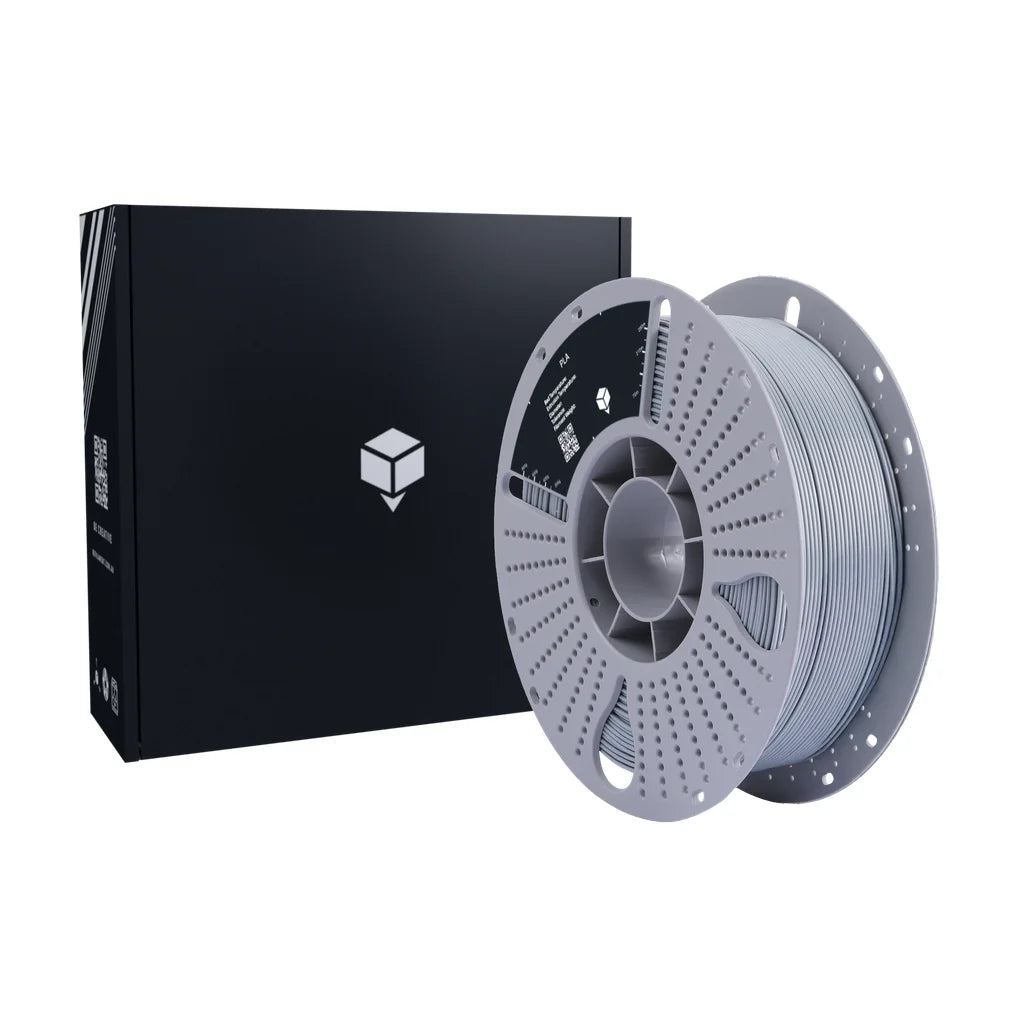

Collection: PA (Nylon)

Our PA (Nylon) filament is an engineering-grade thermoplastic combining exceptional toughness, abrasion resistance, and a naturally low friction coefficient. Available in PA6 and PA12 grades, suitable for gears, bushings, snap-fits, and structural components.

6 products

About PA (Nylon) Filament

PA (Polyamide), commonly known as nylon, is an engineering-grade thermoplastic valued for its exceptional toughness, abrasion resistance, and chemical resistance. Blue Ember stocks two grades: PA6 and PA12. Both are significantly tougher than PLA or ABS and maintain structural integrity under repeated impact and flex loading, making them a preferred choice for demanding functional parts.

PA6 (Polyamide 6) offers higher stiffness and better thermal resistance, while PA12 (Polyamide 12) is more forgiving to print, less sensitive to moisture absorption, and provides excellent fatigue resistance. Both grades have a naturally low friction coefficient, which makes them well suited to components that slide, rotate, or wear against other surfaces over time.

The primary challenge with nylon is moisture. PA filaments are hygroscopic and readily absorb water vapour from the air, causing bubbling, poor surface finish, and weakened layer adhesion during printing. Drying the spool before printing and using sealed storage between sessions are non-negotiable for consistent results.

When to Choose PA (Nylon) Filament

Nylon is the right choice when parts need to be tough without being brittle. Unlike ABS, which absorbs impact rigidly, nylon distributes mechanical stress, making it ideal for parts subject to repeated loading, sliding contact, or fatigue. Common applications include gears, bushings, cable guides, snap-fit connectors, hinges, protective covers, and wear-resistant fixtures.

PA12 is a good starting point for those new to nylon printing: it is more forgiving with moisture and temperature than PA6 and still delivers excellent abrasion resistance and fatigue strength. PA6 suits applications where higher stiffness or greater thermal resistance is required, such as under-bonnet automotive components or parts used near heat sources.

Nylon is not ideal for parts requiring tight dimensional tolerances straight off the build plate, as the material can absorb atmospheric moisture post-print and exhibit slight dimensional changes over time. It is also not recommended without adequate drying and sealed storage equipment, or for users unwilling to manage its moisture sensitivity.

PA (Nylon) vs Alternative Filaments

Nylon sits above ABS and PETG in toughness and abrasion resistance, but requires more careful handling. The choice between PA6 and PA12 is largely determined by how demanding the application is; PA6 delivers more in exchange for a harder printing process.

Property PA6 PA12 ABS PETG
Toughness Very high High High Moderate
Heat Resistance 110–130°C 100–120°C 90–100°C 70–80°C
Abrasion Resistance Excellent Excellent Moderate Moderate
Print Difficulty Hard Moderate to hard Moderate to hard Moderate
Moisture Sensitivity High Moderate Low Low

PETG is considerably easier to print and suits many functional applications, but cannot match nylon's abrasion resistance or fatigue strength. ABS is comparable in toughness but lacks nylon's ability to flex and recover repeatedly without failure. If nylon's moisture requirements are a concern, ABS or PETG are more practical starting points.

If nylon isn't the right fit for your application, explore our PETG, ABS, or carbon fibre filament collections for alternative materials.

Printing PA (Nylon) Successfully

Drying is the first step, not an afterthought. Even a spool that has been sealed for weeks should be dried before printing: 4–8 hours at 70–80°C in a filament dryer or low-temperature oven. Signs of moisture-contaminated nylon include popping or crackling during extrusion, a rough or foamy surface finish, and significantly reduced layer adhesion.

Temperature settings: PA6 typically requires a nozzle temperature of 240–260°C; PA12 prints at 230–250°C. Bed temperatures of 70–90°C are recommended, with a PEI surface or garolite providing the most reliable first-layer adhesion for nylon. Avoid glass beds without an adhesive, as nylon adheres poorly to cold glass.

Environment and hardware: An enclosed build chamber reduces warping and improves layer bonding, particularly for PA6 and for larger prints. Cooling fans should be run at low speed or disabled, as nylon benefits from slow, even cooling. A direct drive extruder provides more consistent extrusion, though well-tuned Bowden setups can work. Standard brass nozzles are adequate for unfilled nylon grades; switch to hardened steel for PA-CF variants.

Printer Compatibility

Most FDM printers capable of reaching 250°C can print nylon, but reliable results depend on proper environmental conditions and bed adhesion.

  • Enclosed printers: Strongly recommended, particularly for PA6 and larger prints. Printers such as the Bambu Lab P1S, X1C, and Prusa MK4S with an enclosure kit maintain stable ambient temperatures that significantly reduce warping and layer separation.
  • Open-frame printers: Can print PA12 with acceptable results in low-humidity environments. PA6 is more prone to warping on open-frame machines and benefits strongly from an enclosure or draught shield.
  • Direct drive vs Bowden: Direct drive is preferred, as nylon's slight flexibility can cause inconsistency in longer Bowden tubes. Bowden setups work but require retraction tuning to avoid stringing.
  • Heated bed: Required. A bed temperature of at least 70°C is needed for adequate adhesion; PEI or garolite surfaces are recommended over plain glass.
  • Nozzle: Standard brass nozzles suit unfilled PA6 and PA12. Use hardened steel for PA-CF grades.

Printers from Bambu Lab, Prusa, Creality, AnyCubic, and Elegoo can all print nylon when configured appropriately. Verify that your printer can sustain nozzle temperatures of at least 250°C and bed temperatures of 70–90°C.

PA (Nylon) Filament FAQs

Nylon is hygroscopic and absorbs moisture from the air. When wet filament passes through the hot nozzle, the water vaporises and causes bubbling, crackling, a rough surface finish, and significantly weakened layer adhesion. Drying for 4–8 hours at 70–80°C before printing removes absorbed moisture and restores print quality. Filament should also be stored in a sealed container with desiccant between print sessions.
PA6 is stiffer, has higher heat resistance, and absorbs more moisture. It requires more careful printing conditions but delivers better mechanical performance in demanding applications. PA12 is easier to print, less moisture-sensitive, and still offers excellent fatigue resistance and abrasion resistance. PA12 is a good starting point for users new to nylon; PA6 suits higher-performance requirements.
Warping in nylon is reduced by printing in an enclosed build chamber, using a heated bed at 70–90°C with a PEI or garolite surface, and minimising cooling fan speed. Ensuring the first layer is well-adhered and using a brim for parts with small contact areas also helps. Dry filament prints with notably less warping than moisture-contaminated filament.
Store nylon in an airtight container or vacuum bag with fresh silica gel desiccant. PA6 absorbs moisture faster than PA12 and degrades more noticeably when wet. If a spool has been left open for an extended period, dry it before using regardless of visible condition. A filament dry box that feeds directly into the printer is ideal for longer print sessions.
Nylon emits caprolactam and other volatile compounds during printing. While the levels produced by a single printer are generally low, adequate ventilation is still recommended. Printing in an enclosure vented outdoors, or in a well-ventilated room, minimises exposure. Avoid prolonged printing in small, unventilated spaces.