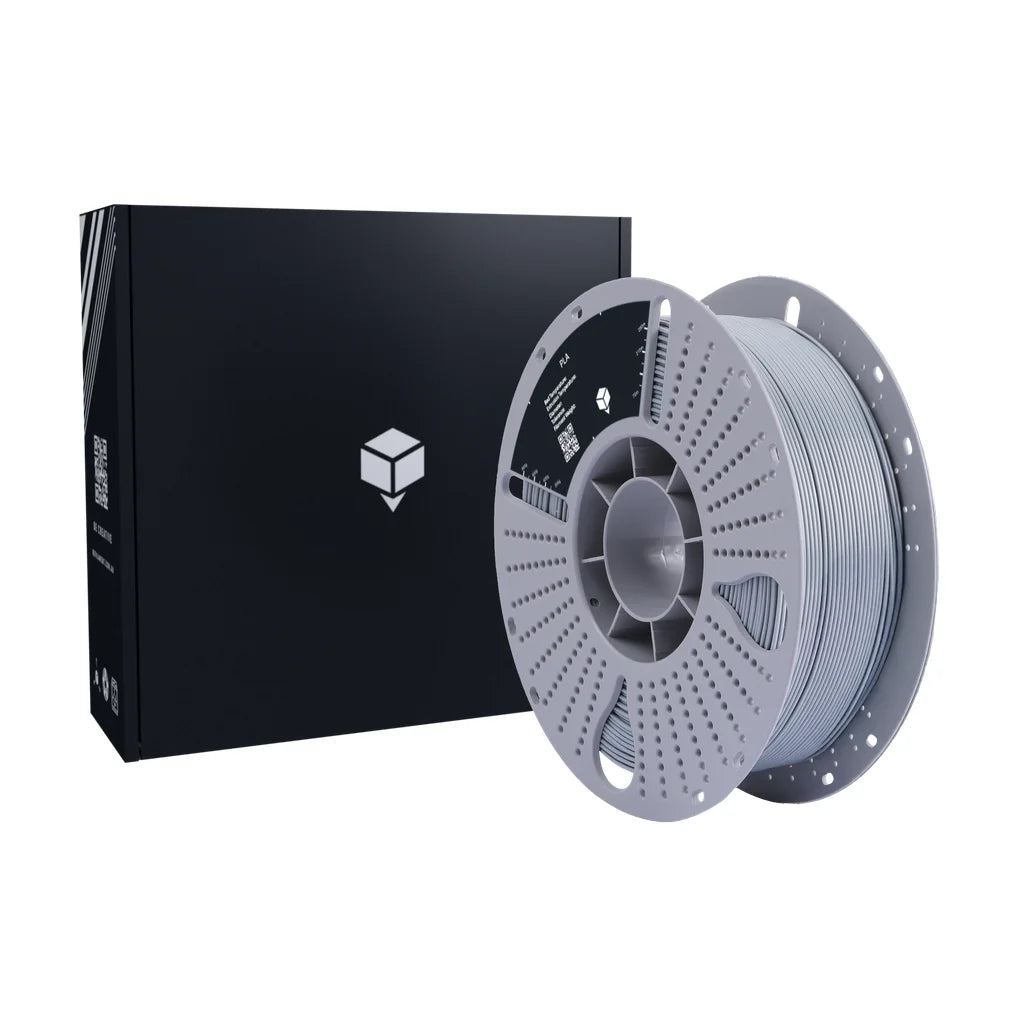

Collection: PLA

Elevate your 3D printing with our PLA. Designed for improved strength, better layer adhesion, and reduced warping. Perfect for high-quality prints with vibrant colours and a smooth finish, it's ideal for both beginners and experienced makers.

18 products

About PLA Filament

PLA (Polylactic Acid) is the most popular 3D printing material, known for its ease of use, reliability, and beginner-friendly printing characteristics. Made from renewable resources like corn starch or sugarcane, PLA is biodegradable under industrial composting conditions, making it an environmentally conscious choice. It prints at lower temperatures than most filaments, doesn't require a heated bed (though one helps), and produces minimal warping, allowing reliable prints on nearly any FDM printer.

PLA offers excellent dimensional accuracy, smooth surface finish, and vibrant colour reproduction. It's available in a wide variety of colours and speciality finishes, including our range of PLA variants: standard PLA for everyday printing, PLA Matte for a refined non-glossy finish, PLA Silk for a lustrous sheen, PLA Marble for a stone-like appearance, PLA Wood for a natural timber aesthetic, and PLA Glow for parts that glow in the dark. Our PLA filament is manufactured to tight tolerances of ±0.02mm at 1.75mm diameter for consistent, reliable performance.

While PLA excels at producing detailed models, prototypes, and decorative items, it has limitations for functional applications. The material softens at relatively low temperatures (around 60°C), making it unsuitable for parts exposed to heat or direct sunlight. PLA is also brittle compared to materials like PETG or ABS, meaning it can crack under impact or stress rather than flex. However, for visual quality, ease of printing, and desktop prototyping, PLA remains unmatched in accessibility and print success rate.

When to Choose PLA Filament

Choose PLA when you need reliable, high-quality prints with minimal hassle, especially for visual models, prototypes, decorative items, and parts that won't experience heat or mechanical stress. PLA is ideal for miniatures and figurines, architectural models, concept prototypes, educational projects, decorative household items, cosplay props and costumes, visual aids and demonstrations, and rapid iteration where print success is more important than material strength.

Select PLA when print quality, colour accuracy, and surface finish are priorities. The material captures fine details excellently and produces smooth surfaces that require minimal post-processing. PLA's wide colour range and specialty variants allow creative expression not easily achieved with engineering materials. It's perfect for projects where the final part won't be subjected to stress, heat, or outdoor conditions.

PLA suits all skill levels from beginners to experts. It's the recommended first filament for anyone learning 3D printing due to forgiving temperature settings, minimal warping, and compatibility with essentially all FDM printers. Advanced users choose PLA when they need guaranteed print success, maximum detail resolution, or specific aesthetic finishes available in PLA variants.

Consider alternatives if you need parts that withstand temperatures above 50-60°C (use PETG, ABS, or ASA), require impact resistance or flexibility (use PETG or TPU), will be used outdoors with sun exposure (use ASA or PETG), or need functional mechanical parts under continuous stress (use PETG or ABS). PLA's brittleness and low heat tolerance make it unsuitable for demanding functional applications, though it excels in its intended use cases.

PLA vs Alternative Filaments

Understanding how PLA compares to other materials helps you choose the right filament for your application. PLA prioritises ease of printing and visual quality over mechanical performance, making it ideal for non-functional parts while other materials excel in demanding applications.

Property PLA PETG ABS TPU
Print Difficulty Easy Moderate Moderate to hard Moderate to hard
Heat Resistance 50-60°C 70-80°C 90-100°C 60-70°C
Durability Brittle under stress Good impact resistance High impact resistance Excellent flexibility
Typical Applications Models, prototypes, decor Functional parts, containers Functional parts, tooling Flexible parts, grips
Surface Finish Excellent (smooth, detailed) Good (glossy) Good (can be smoothed) Moderate (textured)

PETG offers better strength and heat resistance but requires more attention to stringing and bed adhesion. ABS provides superior mechanical properties and heat resistance but demands an enclosure and ventilation. TPU delivers flexibility that PLA cannot match but prints more slowly and requires specific hardware. PLA remains the easiest and most reliable choice for non-functional applications.

If standard PLA isn't the right choice for your application, explore our speciality PLA Matte, PLA Silk, PLA Wood, or other PLA variants for different aesthetic finishes, or consider PETG for functional parts.

Printing PLA Successfully

PLA is the most forgiving 3D printing material, making it ideal for beginners while still delivering professional results. The material's low printing temperature and minimal warping allow successful prints on nearly any properly configured FDM printer.

Temperature settings: Nozzle temperatures typically range from 190-220°C, with most users finding success around 200-210°C. Start at 200°C and adjust based on your printer and desired finish—higher temperatures improve layer adhesion but may reduce detail sharpness. Bed temperature should be set between 40-60°C if using a heated bed, with 50-60°C being optimal. PLA can print on unheated beds with proper adhesion aids like painter's tape or glue stick.

Speed and cooling: PLA prints reliably at moderate to fast speeds (50-80mm/s), making it efficient for large models. Enable part cooling fans at 100% after the first layer to improve overhangs, bridges, and fine details. Unlike PETG or ABS, PLA benefits from aggressive cooling, which solidifies layers quickly and produces sharper details. Reduce speed for intricate details or enable supports for overhangs exceeding 45 degrees.

Common challenges: Stringing occurs when nozzle temperature is too high or retraction is insufficient—reduce temperature in 5°C increments and ensure retraction is enabled (typically 4-6mm for Bowden, 1-3mm for direct drive). Poor bed adhesion can be resolved with proper bed levelling, clean print surface, and adequate bed temperature. If prints are too brittle, increase nozzle temperature slightly for better layer bonding. PLA rarely warps, but ensure the first layer is properly squished for best adhesion.

Printer Compatibility

PLA works on virtually every FDM 3D printer, from budget models to professional machines. Its low printing temperature and forgiving nature make it universally compatible without requiring special hardware or modifications.

  • Heated bed beneficial but optional: While PLA can print on unheated beds with adhesion aids (painter's tape, glue stick), a heated bed at 50-60°C significantly improves first-layer adhesion and reduces the chance of prints detaching mid-print. Most modern printers include heated beds as standard.
  • No enclosure required: Unlike ABS or ASA, PLA doesn't require temperature-controlled environments. It prints successfully on open-frame printers in typical room conditions without warping issues, making it ideal for desktop and educational settings.
  • All extruder types compatible: Both direct drive and Bowden extruders print PLA excellently. The material feeds reliably through Bowden tubes without buckling and retracts cleanly to minimise stringing. PLA is often used to test and calibrate new printers due to its predictable behaviour.
  • Standard nozzles sufficient: PLA prints perfectly with standard brass nozzles at 0.4mm diameter. Smaller nozzles (0.2-0.3mm) capture finer details, while larger nozzles (0.6-0.8mm) speed up prints for functional parts. Hardened steel nozzles aren't necessary unless printing abrasive variants like PLA Wood.

Every major printer brand—Prusa, Bambu Lab, Creality, AnyCubic, Elegoo, Artillery, and more—prints PLA reliably out of the box. Even basic printers without heated beds can produce successful PLA prints with proper surface preparation. PLA is the recommended calibration material for new printers and the ideal starting point for learning 3D printing.

PLA Filament FAQs

PLA is biodegradable under industrial composting conditions (high temperature and humidity), but it won't break down in home compost bins or natural environments within reasonable timeframes. While made from renewable resources and more environmentally friendly than petroleum-based plastics, PLA prints should be disposed of responsibly through industrial composting facilities where available, or standard recycling streams.
Reduce nozzle temperature in 5°C increments starting from your current setting, ensure retraction is enabled in your slicer (typically 4-6mm for Bowden, 1-3mm for direct drive), increase retraction speed if needed, and verify your filament is dry. Moisture-saturated PLA causes excessive stringing and poor surface quality. A temperature tower test helps identify the optimal printing temperature.
PLA works for low-stress functional parts that remain indoors at room temperature. It's suitable for organizers, brackets, light-duty mounts, and prototypes for testing fit and form. However, avoid using PLA for parts experiencing heat (above 50°C), significant stress or impact, outdoor sun exposure, or repeated flexing. For functional applications, consider PETG or ABS instead.
Store PLA in an airtight container or sealed bag with silica gel desiccant. While less hygroscopic than nylon or PETG, PLA gradually absorbs moisture from humid environments, leading to stringing, bubbling sounds during printing, and poor surface finish. If PLA has absorbed moisture, dry it in a filament dryer or food dehydrator at 45-50°C for 4-6 hours before printing.
Standard PLA offers reliable printing and glossy finish. PLA Matte provides a refined non-glossy surface. PLA Silk delivers a lustrous, satin-like sheen. PLA Marble creates stone-like patterns. PLA Wood includes wood fibres for a natural timber appearance. PLA Glow glows in the dark after light exposure. All variants share PLA's easy printing characteristics with aesthetic differences in finish and appearance.